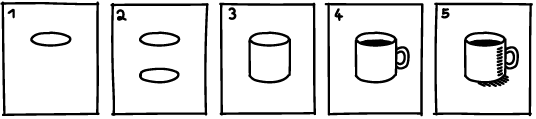
Many drawing tutorials show us how to draw things.
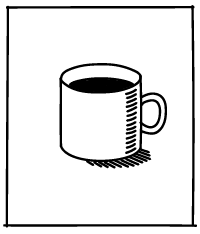
They teach us how to make photo-like drawings. Such renderings look decent but also generic, conventional—like something an AI tool might produce.
And they are boring.
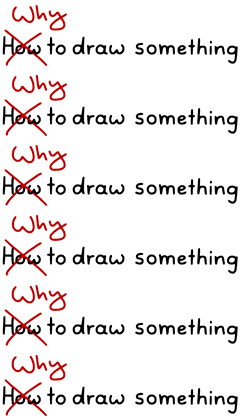
Why is that?
Because they don’t mean anything.
Meaning
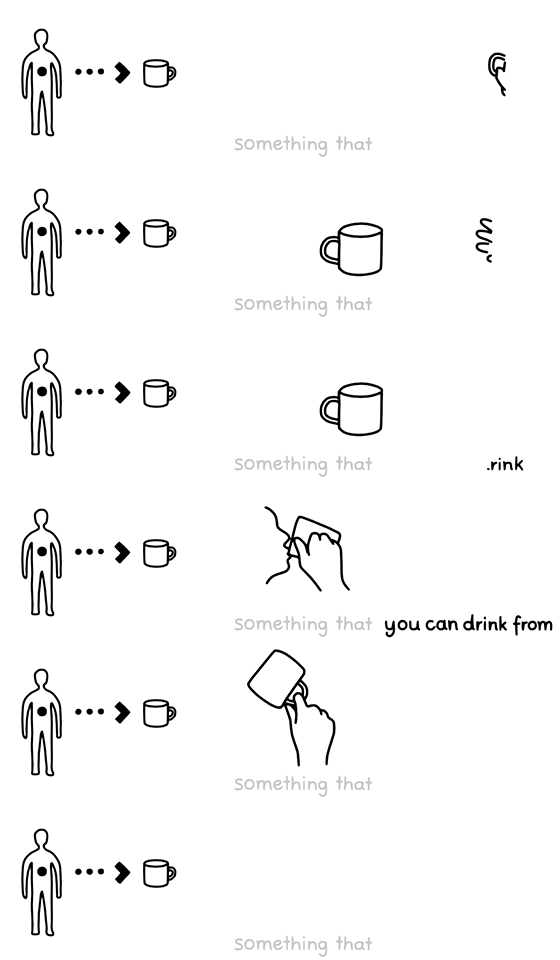
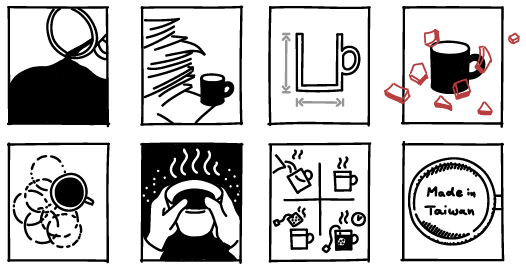
An object, like a cup, can mean many different things to us.
Now the question is: Which meaning is relevant to you right now?
And the answer to this question is what makes your drawing interesting. You just need to show it.
But how?
Composition
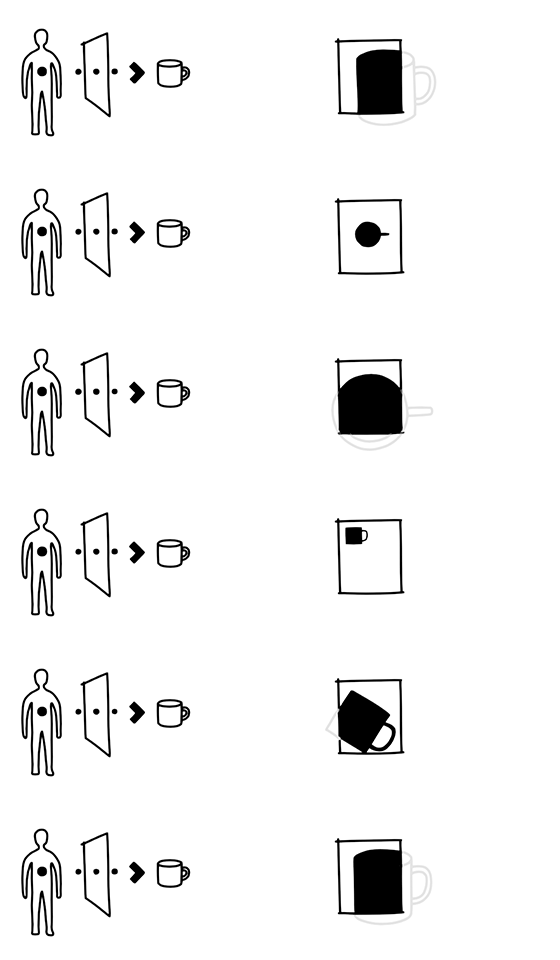
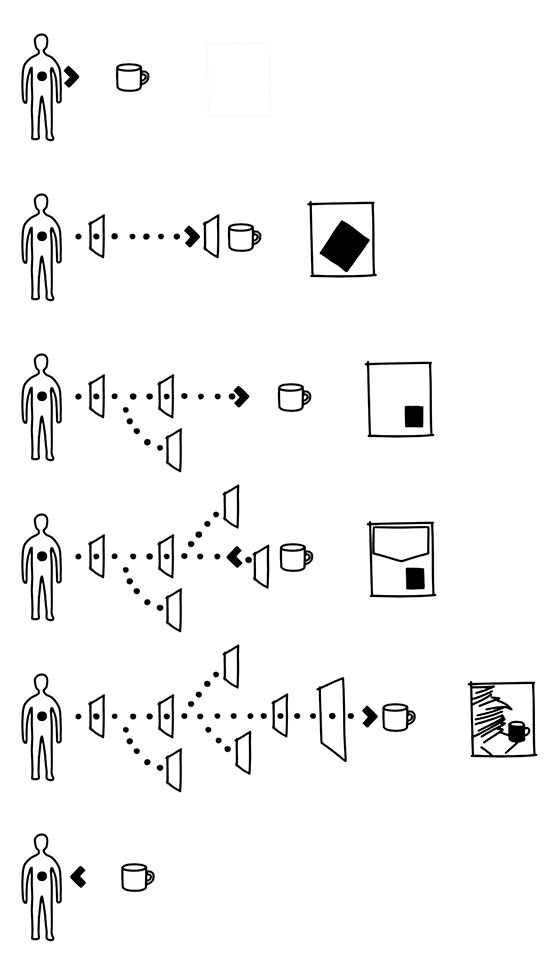
We must understand that a drawing is very different from the real thing. For instance, a picture can only show one view. So we have to pick the best view of the object and decide where to put it within the bounds of our paper.
Or in other words: We need to compose the picture.
And this composition will have a drastic impact on how the object appears to us.
Principles
There are no strict rules on how to do this. Instead, artists and designers prefer to speak of principles that can guide our decisions.
Here is a selection of my favourites:
Space
We see the picture plane as an enclosed space with its own rules.
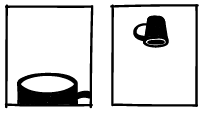
Gravity
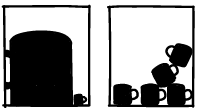
These rules are in part shaped by our perceptual habits. For example we impose our experience of physical laws on the shapes we see in a picture. Big shapes at the bottom seem to be “heavy”.
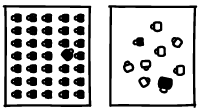
Relation
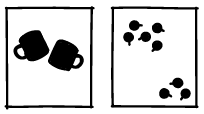
Just as we recognize relationships between things, animals and people in the real world, we see them in visual elements as well.
When individual forms stand out from the rest, we notice them first. They seem more important. This is how we can create visible hierarchies.
Perspective
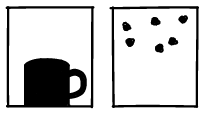
We can also pick a view point in our picture space to suggest a physical relationship to the objects. For example, a thing can appear “bigger than me” or “above me”.
Depth
In this way, we can also suggest spatial depth, which implies a sense of time. What is close appears “urgent”, things that are farther away “come later”.
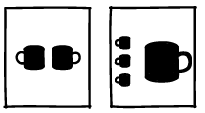
Harmony
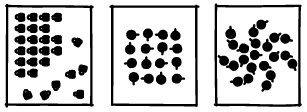
Harmony in a composition suggests that everything is fine. The extreme case is perfect symmetry. Yet we can also position elements of different sizes carefully to retain a sense of balance.
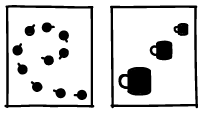
Movement
And finally, linear arrangements can suggest movement and bring static images to life.
Process
We can use these principles to show a particular meaning. However, this requires that we are clear about why we want to draw that thing in the first place.
But even with a clear goal in mind, the workflow to our composition is rarely straightforward. Like many creative processes, image composition can be messy and unpredictable.
Most of the time, we try out many variations to gradually work our way toward a solution.
Every drawing is a self portrait
Of course there are more choices to be made about colour, style or what type of image to create. Yet, I am convinced that composition remains the primary decision. It is the key to intriguing and authentic drawings that show more than just lifeless renderings.
Carefully composed drawings can show our relation to the world.
And that is interesting.
It is interesting because we have made a conscious choice of what is important to us. And chances are that this is also interesting for others.
So to bring your drawings to the next level—after learning how to draw something—is to show why you draw it. And then, perhaps your drawing makes us see something in a new way: your way.
If you are interested in truth, be it in the form of scientific knowledge or artistic beauty, there is no way around Immanuel Kant’s ‘Critique of Pure Reason’. In this book Kant asked the simple question: “What can we know?“
Last summer, I found myself at a farmers market of a small town in Southern France. The air was alive with chatter and the joy of yet another sunny day ahead. I made my way through tourists, neighbourhood regulars and other early birds. To escape the buzz, I stepped into the nearby cathedral.
How do we know which food is best for us? We might start a low-carb diet. Then we switch to whole grains, or even go fully vegan—only to return to a low-carb diet yet again. We constantly change our minds.
Designers share a problem with politicians and business consultants: nobody knows what they are actually doing. I can shed some light on what designers do.
Some people claim that there is no truth. According to these sceptics everybody is stuck in their own personal perspective. Nobody can ever know anything for sure.
The Yijing 易經 or “Book of Change” is one of China’s oldest books and a corner stone of Chinese philosophy. It tells us how to understand change, how to find out what kind of change we are in right now, and how to deal with it.
How can we tell what is real and what isn’t? Ludwig Wittgenstein said that it was all about language. If we want to understand what we can know, then we must look at how language works.
So he wrote two very different books on how we use language to think.
Until recently everyday objects were shaped by their technology. The design of a telephone was basically a hull around a machine. The task of the designers was to make technology look pretty.
Many creatives know this phenomenon: They start a new project on a promising topic with excitement, but when they can’t come up with an original idea instantly — they lose interest. They come to the conclusion that they picked the wrong topic. So they restart with a new topic, only to find out that the grass isn’t any greener on that side of the fence either.
It is fashionable to be outraged about lies in mass media. News agencies, corporations, and — God forbid! — even politicians all seem to mislead us. And they get away with it! How is that possible? Niklas Luhmann has some answers in his classic book from 1995 titled “The Reality of Mass Media”.
In 1942 Albert Camus wrote a book called “The Myth of Sisyphus”. It is about the one truly important philosophical problem: Given the circumstances of our existence, shouldn’t we just kill ourselves? This is his answer:
This article is a quick summary of a basic design course. It addresses a simple question: How do you design interactive systems that are easy to understand? Well, it all comes down to two things: structure and process.
The digital revolution was a gold rush for curious minds. Nobody knew what digital media actually was, only that it was about to impact our lives profoundly. It was unknown territory waiting to be filled with new artforms, designs and ways to understand the world.
Almost any creative person I know has to deal with heavy doubts in their process. And to a certain extent this might be an unavoidable part of our artistic lives. But I might at least pull one painful thorn out of your side: The question of whether your project (yes, the one from which you are procrastinating right now!) is good enough or not.
We are obsessive problem solvers. When we see something imperfect, our perception wants to figure out what is going on — we get curious. On the other hand, when something is too irregular or “crappy” we ignore it as irrelevant noise.
One of the biggest mistakes you can make in your creative project is to pick a topic which is too big.
As an artist and designer I keep making one mistake time and again. So if this article sounds like me giving advice to other creatives… it is actually an attempt to keep myself from making this mistake yet again.